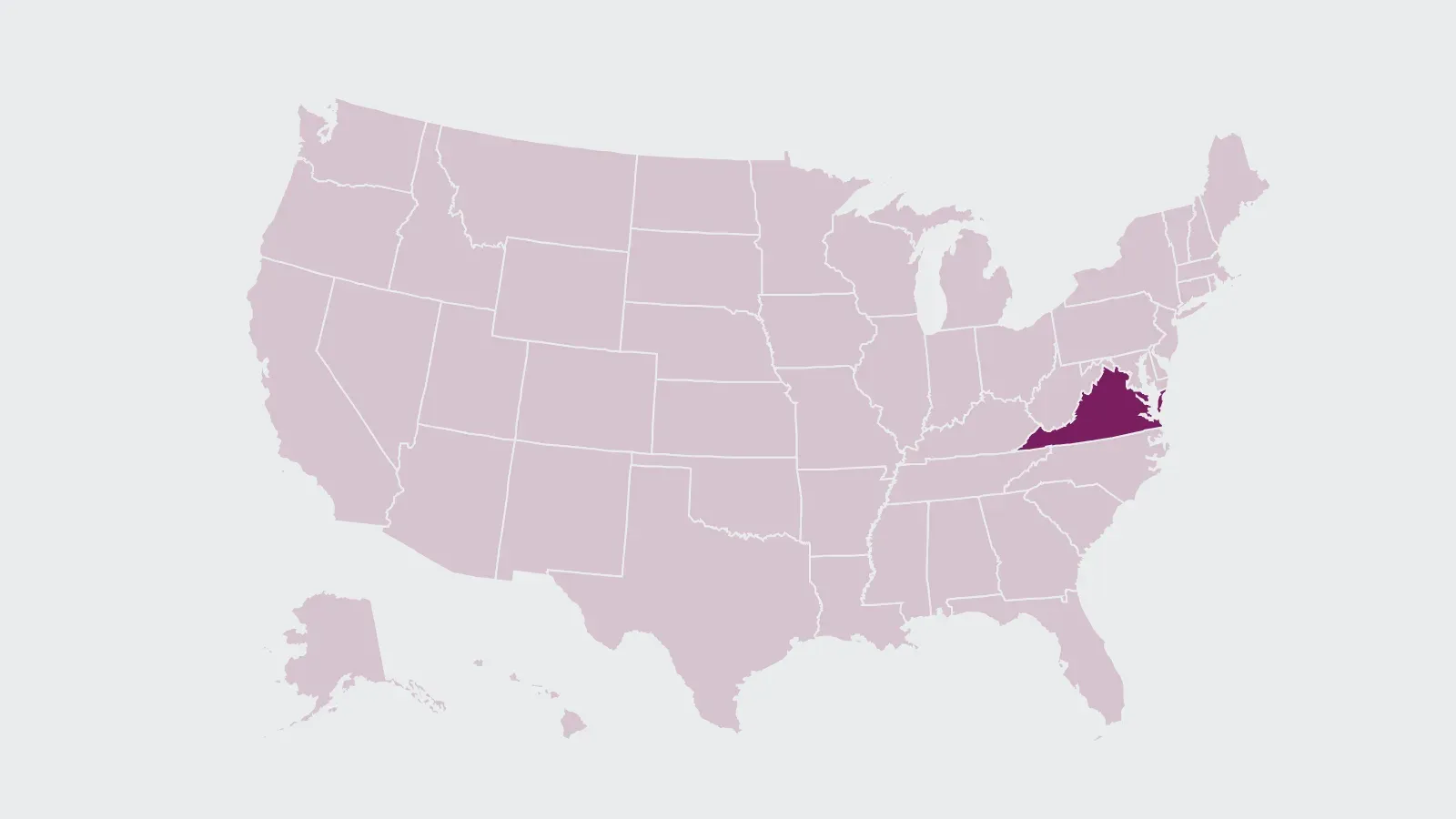
$1,000–$1,249 tier
What car insurance costs in Virginia
Virginia's average premium against the national figure, two recent law changes that reach every driver's bill, and practical ways to trim it.
By Guardbrook Editorial Team Updated 6 min read
At a glance
- Average yearly spend, 2023
- $1,114
- Change from 2022
- +17%
- Minimum liability limits
- 50/100/25
- Uninsured drivers, 2023
- 12.9%
Bottom line
Virginia drivers spent an average of $1,114 per insured car in 2023, about 13% less than the U.S. average of $1,282, and a car with all three main coverages averaged $1,238. Two changes since then reach every driver: since July 1, 2024 you can no longer pay a fee instead of insuring a car, and policies effective on or after January 1, 2025 must carry at least 50/100/25 liability. Neither shows in the 2023 averages.
The Virginia bill, line by line
Guardbrook
Average car insurance bill, 2023
Virginia
Liability$627
Collision$407
Comprehensive$204
Full coverage$1,238
Average spend per car$1,114
Compared with the U.S.−13%
Uninsured drivers12.9%
Average yearly premiums per insured car (NAIC); uninsured share: Insurance Research Council estimate. Averages, not a quote. Where these numbers come from
Price tier on the map
$1,000 to $1,249 a year
- Minimum liability limits
- 50/100/25
- Policies effective on or after Jan. 1, 2025; UM/UIM at matching limits; fee-instead-of-insurance option ended July 1, 2024
- Credit-based insurance scores
- Allowed, with limits
- Va. Code § 38.2-2234: notice of adverse action, banned factors, exceptions for catastrophic events
- Regulator
- Virginia State Corporation Commission
Virginia's 2023 bill next to the U.S.
The National Association of Insurance Commissioners (NAIC) tracks what insurers collect in each state. Its 2023 state figures, the latest available, show an average Virginia expenditure of $1,114 per insured car, 17% above the $950 of 2022. Expenditure combines cars with liability only and cars with full coverage. A car carrying liability, collision and comprehensive cost $1,238 on average.
| Coverage | Virginia | United States |
|---|---|---|
| Liability | $627 | $737 |
| Collision | $407 | $464 |
| Comprehensive | $204 | $238 |
| All three (combined premium) | $1,238 | $1,438 |
| Average expenditure | $1,114 | $1,282 |
The gap is even across the board: liability, collision and comprehensive each run roughly 12% to 15% below the national averages. The 17% jump from 2022 was larger than the 14% national increase. Keep in mind that these numbers come from a year when Virginia's minimum was 30/60/20 and some owners paid a fee instead of buying insurance, so they don't reflect what the newer rules cost. Your own price also turns on your car, record and garaging address; see how location sets a price.
What Virginia now requires on every car
For policies effective on or after January 1, 2025, Virginia Code § 46.2-472 sets the minimum at $50,000 for injury or death of one person, $100,000 for two or more people and $25,000 for property damage. From 2022 through 2024 it was 30/60/20.
- No more paying to skip insurance. Effective July 1, 2024, Virginia eliminated the option to pay a fee rather than insure a vehicle. Every car registered in the state must carry a policy that meets the liability limits, and you certify coverage when you buy plates or decals.
- Going uninsured is costly. Operating an uninsured vehicle is a Class 3 misdemeanor. DMV suspends the owner's license and registration until a $600 noncompliance fee is paid, and reinstatement requires an SR-22 filing for three years.
- Uninsured/underinsured motorist coverage is part of every policy at limits equal to your liability limits. Any named insured can lower it, but not below the 50/100/25 state minimum.
A lapse now has firm consequences, since DMV electronically checks insurance on Virginia-registered vehicles with insurers. If you are changing companies, start the new policy before the old one ends; our page on what a coverage gap does to your price explains why.
Pricing, credit and a mandated discount
Under Virginia Code § 38.2-1906, insurers must file their rates on or before the date the rates take effect. Virginia Code § 38.2-2234 sets rules for credit in personal auto insurance. If credit leads to a denial, a higher premium, a lost discount or a worse tier, it must send a notice giving the main reasons or telling you how to ask for them. Income, gender, address, ZIP code, race, marital status and your total available credit can't be used. Credit must be refreshed at least every three years, or sooner if you ask. An insurer may also grant exceptions for catastrophic events such as serious illness or the death of a spouse. See credit-based insurance scores.
Virginia Code § 38.2-2217 requires auto insurance rates to include an appropriate reduction for insured drivers 55 and older who complete an approved driver improvement course. The reduction lasts three years after the course, and you retake it every three years to keep it. More on course discounts.
Help for drivers insurers turn away
Virginia has a residual-market automobile insurance plan for drivers who can't buy a policy in the regular market; it is one of the state plans run through AIPSO, and an agent submits the application. With insurance now mandatory for every registered car, it matters as a last resort. The guide to assigned risk plans explains costs and limits.
Ways to bring a Virginia premium down
- Requote after your 2025 renewal. If the new 50/100/25 floor raised your price, compare two or three companies on the same limits and deductibles.
- Claim the mature driver course reduction if you are 55 or older, and ask each insurer how much it gives.
- Look at the deductible. A higher collision and comprehensive deductible lowers the premium; the deductible break-even calculator shows the break-even point.
- Take problems to the regulator. Ask the insurer to explain any credit-based increase first. If that fails, contact the State Corporation Commission, the agency Virginia DMV points drivers to for auto insurance questions.
Questions drivers ask
What is the minimum car insurance in Virginia now?
For policies effective on or after January 1, 2025: $50,000 per person, $100,000 per accident for injuries and $25,000 for property damage (50/100/25), with uninsured/underinsured motorist coverage at matching limits.
Can I still pay a fee instead of buying insurance in Virginia?
No. Virginia DMV says the option to pay a fee rather than maintain insurance was eliminated effective July 1, 2024. Every registered vehicle must be insured.
Is car insurance in Virginia cheaper than average?
In 2023, yes: NAIC data put the average Virginia expenditure at $1,114 per insured car against $1,282 nationally. Those figures predate the higher 2025 minimums.
Do Virginia insurers have to give a discount for a driver improvement course?
For drivers 55 and older who complete an approved course, Virginia law requires an appropriate reduction for three years. See course discounts.
Where the figures come from
- NAIC — Auto Insurance Database Report 2022/2023 (state average premiums and expenditures)
- Virginia DMV — Insurance requirements
- Virginia DMV — New laws take effect July 1, 2024
- Code of Virginia § 46.2-472 — Minimum liability limits
- Code of Virginia § 46.2-707 — Operating an uninsured motor vehicle
- Code of Virginia § 38.2-2202 and § 38.2-2206 — Uninsured/underinsured motorist coverage
- Code of Virginia § 38.2-2234 — Use of credit information in motor vehicle insurance
- Code of Virginia § 38.2-2217 — Driver improvement course reductions
- Insurance Information Institute — Uninsured motorists (Insurance Research Council estimates)
Facts on this page were checked against these sources on October 26, 2026. NAIC averages are for 2023, the latest year the NAIC has published by state.
Have your rate shopped
Averages can't price your car and your record. Tell us the basics of your policy and Guardbrook passes them to licensed insurance agents and insurers who can quote it; you decide whether to switch.
- 1 Your cars, drivers and current policy.
- 2 How agents can reach you, and your consent.
- 3 A licensed insurance agent or insurer contacts you with quotes. Your policy stays as it is until you decide to switch.
Guardbrook is not an insurance company or agency and doesn't sell, quote or bind policies. You pay Guardbrook nothing; the licensed insurance agents and insurers who contact you set their own prices and terms. How we make money.
Read next
-

Price factor
Insurance lapse
A gap can cost you twice: state penalties (a $600 fee in Virginia) and a higher price at the next quote.
-

Way to save
Defensive driving course discount
At least 10% in Minnesota for drivers 55+, 10% in Delaware at any age. State rules, how long it lasts, how to claim.
-

Shopping guide
Switching insurers without a gap
Start the new policy first, cancel in writing, tell the lender. A North Carolina lapse can cost up to $200 in fees.