$1,000–$1,249 tier
What car insurance costs in Washington
Washington's average premium beside the national one, the coverage you must buy or turn down in writing, and how the state reviews prices.
By Guardbrook Editorial Team Updated 6 min read
At a glance
- Average yearly spend, 2023
- $1,153
- Change from 2022
- +10%
- Minimum liability limits
- 25/50/10
- Uninsured drivers, 2023
- 19.1%
Bottom line
Washington drivers spent an average of $1,153 per insured car in 2023, about 10% below the U.S. average of $1,282, and a car with all three main coverages averaged $1,235. The minimum is 25/50/10. Personal injury protection must be offered and underinsured motorist coverage is included unless you reject them in writing. Rate changes go to the Office of the Insurance Commissioner for review, and insurers may use credit, but not by itself to deny or cancel a policy.
The Washington bill, line by line
Guardbrook
Average car insurance bill, 2023
Washington
Liability$708
Collision$373
Comprehensive$154
Full coverage$1,235
Average spend per car$1,153
Compared with the U.S.−10%
Uninsured drivers19.1%
Average yearly premiums per insured car (NAIC); uninsured share: Insurance Research Council estimate. Averages, not a quote. Where these numbers come from
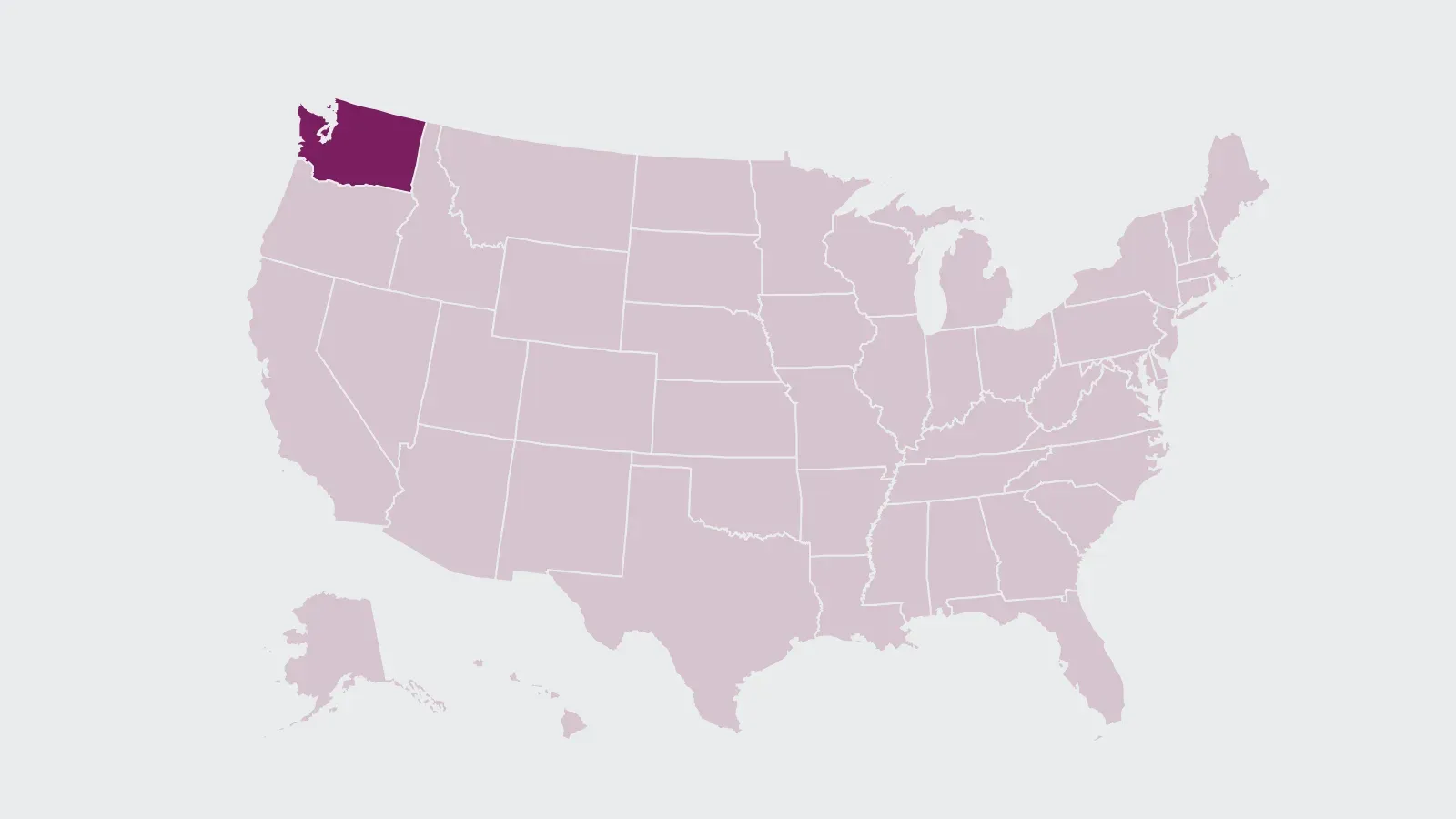
Price tier on the map
$1,000 to $1,249 a year
- Minimum liability limits
- 25/50/10
- PIP must be offered and UIM is included unless rejected in writing (RCW 48.22.085, 48.22.030)
- Credit-based insurance scores
- Allowed, with limits
- No current ban per the OIC; credit alone can't be used to deny or cancel coverage
- Regulator
- Washington State Office of the Insurance Commissioner
Washington's bill beside the national one
The National Association of Insurance Commissioners (NAIC) reports what insurers took in across each state. In its 2023 figures, the newest it has released by state, Washington's average expenditure was $1,153 per insured car, up 10% from $1,048 in 2022, a smaller rise than the 14% national increase. Because that average includes liability-only cars, the figure for a car with all three main coverages, $1,235, is the better guide if you carry full coverage.
| Coverage | Washington | United States |
|---|---|---|
| Liability | $708 | $737 |
| Collision | $373 | $464 |
| Comprehensive | $154 | $238 |
| All three (combined premium) | $1,235 | $1,438 |
| Average expenditure | $1,153 | $1,282 |
Liability is close to the national average, at about 4% below. The savings sit in physical damage: collision is about 20% cheaper than the U.S. figure and comprehensive about 35% cheaper. So a driver who carries only liability sees less of Washington's advantage than one who insures a newer car in full. Within the state, your ZIP code can move the price a good deal; see how location sets a price.
Coverage you must buy or refuse in writing
Liability insurance is mandatory for every motor vehicle and motorcycle in Washington. The Office of the Insurance Commissioner (OIC) lists the minimums as $25,000 for injuries or death to another person, $50,000 for injuries or death to all other people and $10,000 for damage to someone else's property. If you can't show proof of insurance when stopped, you get a traffic ticket.
- Personal injury protection (PIP) must be offered with every new or renewed policy. It is optional: you can reject it, but only in writing, and a rejection carries over to later renewals unless you ask for it back in writing.
- Underinsured motorist coverage is included by default in the same amount as your liability coverage. A named insured or spouse can reject all or part of it in writing.
- About 19.1% of Washington drivers were uninsured in 2023, by the Insurance Research Council's estimate, well above the 15.4% national figure.
With nearly one driver in five uninsured, the underinsured motorist line is often the part of the bill that protects you most directly. Before you reject it or PIP to save money, see our page on which optional coverages are worth cutting.
How Washington reviews rates and credit
Insurers must file auto rate changes with the OIC, which doesn't set rates but reviews filings and either approves or denies them. State law requires rates to be reasonable, and not excessive, inadequate or unfairly discriminatory. The filings are public: you can read them through SERFF Filing Access, linked from the OIC's site.
The OIC says there is currently no ban on insurers using credit information to set premiums. An insurer can't use your credit history by itself to deny coverage or cancel a policy. It may not count the number of credit inquiries, medical collection accounts, a new loan for your first car or home, the type of card you use or your total available credit. If credit keeps you out of the insurer's most favorable rate, the insurer must tell you in writing and give up to four reasons, and you can get a free report from the credit bureau it used. See credit-based insurance scores.
When no company will write a policy
If your driving record keeps agents from offering you coverage, Washington's Automobile Insurance Plan must offer a policy to hard-to-insure drivers. You can contact the plan yourself or have an agent do it. It works best as a temporary step, as our guide to assigned risk plans explains.
Ways to lower a Washington premium
- Compare at least three insurers. Quote the same liability, underinsured motorist and PIP choices so the prices line up.
- Check a proposed increase. If your renewal jumps, look up your insurer's rate filing in SERFF Filing Access to see what it asked the OIC to approve.
- Rethink the deductible. A higher collision and comprehensive deductible lowers the premium; the deductible break-even calculator shows how long the saving takes to cover the risk.
- Ask the OIC for help. File a complaint online, or call the Consumer Advocacy line at 800-562-6900, 8:30 a.m. to 4:30 p.m., Monday through Friday.
Questions drivers ask
How does Washington car insurance compare with the U.S. average?
NAIC data for 2023 put the average Washington expenditure at $1,153 per insured car against $1,282 nationally, and the full-coverage combined premium at $1,235 against $1,438.
Is PIP required in Washington?
Insurers must offer it with every policy, but it is optional for you. To decline it, you must reject it in writing.
Can Washington insurers use my credit score?
Yes. The Office of the Insurance Commissioner says there is currently no ban, but credit history can't by itself be the reason to deny or cancel a policy. See credit-based insurance scores.
What is the minimum car insurance in Washington?
Liability of $25,000 per person, $50,000 for all other people injured and $10,000 for property damage (25/50/10). Underinsured motorist coverage is included unless rejected in writing.
Where the figures come from
- NAIC — Auto Insurance Database Report 2022/2023 (state average premiums and expenditures)
- Washington State Office of the Insurance Commissioner — Mandatory auto insurance law
- Washington State Office of the Insurance Commissioner — How we review auto and homeowner rates
- Washington State Office of the Insurance Commissioner — Credit scores and insurance
- Washington State Office of the Insurance Commissioner — What if I can't find auto coverage?
- RCW 48.22.085 — Personal injury protection: offer and written rejection
- RCW 48.22.030 — Underinsured motorist coverage
- Insurance Information Institute — Uninsured motorists (Insurance Research Council estimates)
Facts on this page were checked against these sources on October 26, 2026. NAIC averages are for 2023, the latest year the NAIC has published by state.
Have your rate shopped
Averages can't price your car and your record. Tell us the basics of your policy and Guardbrook passes them to licensed insurance agents and insurers who can quote it; you decide whether to switch.
- 1 Your cars, drivers and current policy.
- 2 How agents can reach you, and your consent.
- 3 A licensed insurance agent or insurer contacts you with quotes. Your policy stays as it is until you decide to switch.
Guardbrook is not an insurance company or agency and doesn't sell, quote or bind policies. You pay Guardbrook nothing; the licensed insurance agents and insurers who contact you set their own prices and terms. How we make money.
Read next
-
Price factor
Credit-based insurance scores
Allowed in most states, barred from auto rates in CA, HI, MA and MI. Your rights when credit raises the price.
-

Shopping guide
Why your premium went up
Market-wide changes vs. your own record. The price index fell 5.0% to September 2026; yours may not have.
-
Way to save
Trimming optional coverages
Rental, roadside, gap, custom equipment and MedPay: what each pays, when to drop it, and what to keep.