$1,000–$1,249 tier
What car insurance costs in Oklahoma
How the average Oklahoma premium compares with the country's, what state law requires, and the tools Oklahoma gives you to shop.
By Guardbrook Editorial Team Updated 6 min read
At a glance
- Average yearly spend, 2023
- $1,085
- Change from 2022
- +13%
- Minimum liability limits
- 25/50/25
- Uninsured drivers, 2023
- 12.0%
Bottom line
The average Oklahoma driver spent $1,085 per insured car in 2023, about 15% below the U.S. average of $1,282. Full coverage averaged $1,325, and comprehensive cost about 42% more than the national figure. Oklahoma requires 25/50/25 liability. The Oklahoma Insurance Department publishes a chart of sample premiums from about 19 insurers, and state law requires a three-year discount after an accident prevention course.
The Oklahoma bill, line by line
Guardbrook
Average car insurance bill, 2023
Oklahoma
Liability$566
Collision$421
Comprehensive$338
Full coverage$1,325
Average spend per car$1,085
Compared with the U.S.−15%
Uninsured drivers12.0%
Average yearly premiums per insured car (NAIC); uninsured share: Insurance Research Council estimate. Averages, not a quote. Where these numbers come from
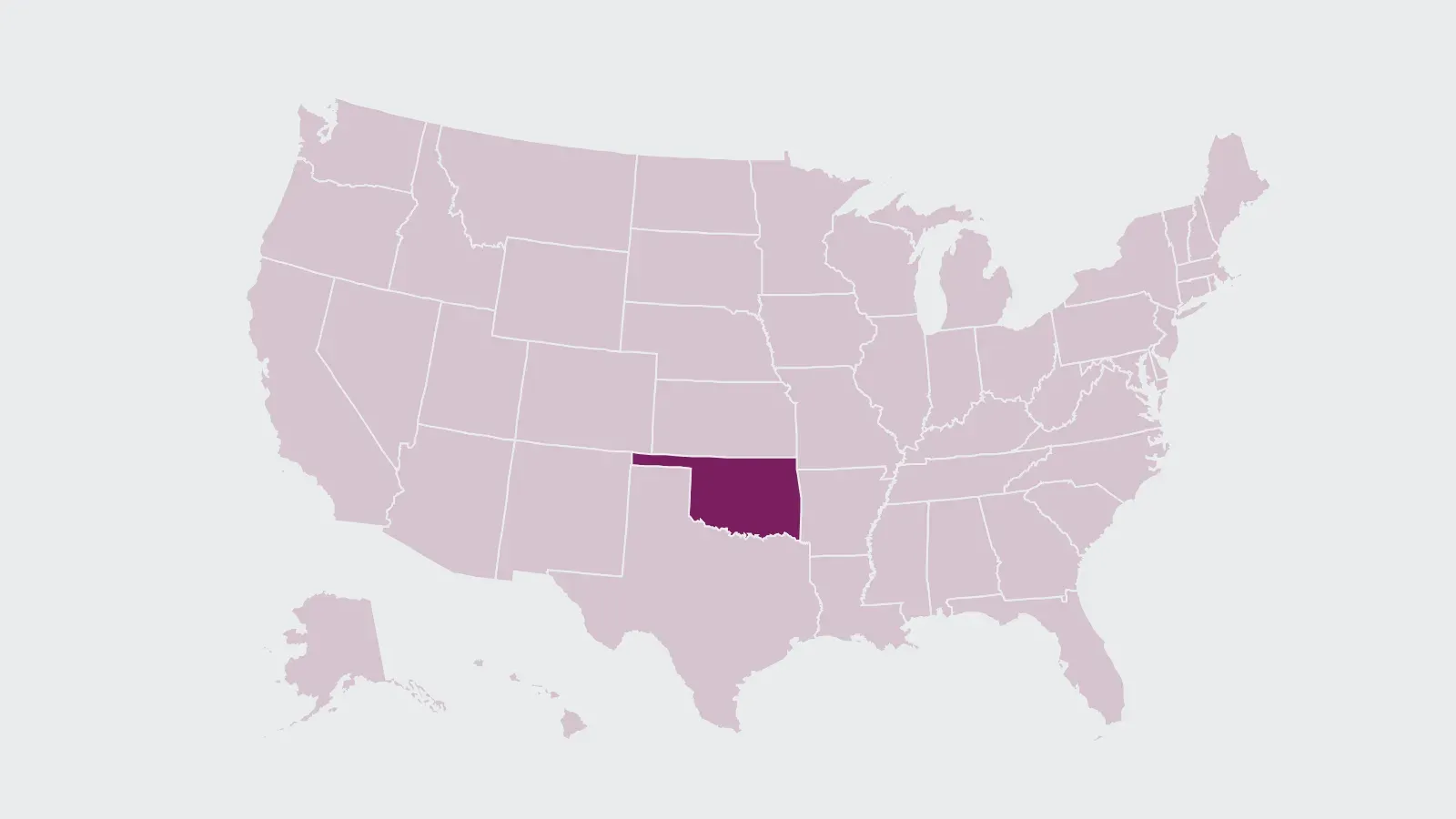
Price tier on the map
$1,000 to $1,249 a year
- Minimum liability limits
- 25/50/25
- Uninsured motorist coverage is optional and, in Oklahoma, covers bodily injury only
- Credit-based insurance scores
- Allowed
- Oklahoma Insurance Department: insurers may use a credit-based insurance score to price or renew
- Regulator
- Oklahoma Insurance Department
Oklahoma's premium against the U.S. figure
Each year the National Association of Insurance Commissioners (NAIC) publishes what insurers collected per insured car in every state. For 2023, its latest state year, Oklahoma's average expenditure was $1,085, up 13% from $959 in 2022. That figure averages liability-only policies together with full coverage. When a car carried liability, collision and comprehensive, the combined premium was $1,325.
| Coverage | Oklahoma | United States |
|---|---|---|
| Liability | $566 | $737 |
| Collision | $421 | $464 |
| Comprehensive | $338 | $238 |
| All three (combined premium) | $1,325 | $1,438 |
| Average expenditure | $1,085 | $1,282 |
Two lines pull in opposite directions. Liability, which pays for harm you cause others, was $171 below the U.S. average. Comprehensive, which pays for damage that isn't a crash, such as theft, fire, hail or a falling tree, was $100 above it. So the gap with the rest of the country narrows once you add physical damage coverage: a fully covered Oklahoma car was only about 8% under the national combined premium. A higher comprehensive deductible is one way to trim that line; see raising your deductible.
The coverage every Oklahoma policy needs
The minimum liability coverage in Oklahoma is 25/50/25: $25,000 for injuries to one person, $50,000 for all injuries in one accident and $25,000 for damage to other people's property. Liability generally follows the car, so if you lend your car with permission, your policy is usually the one that answers.
- Uninsured motorist coverage isn't part of the basic policy, but it can be added. In Oklahoma it pays only for bodily injury, not for damage to your car.
- Medical payments coverage pays reasonable medical bills for you and your passengers after a crash. It isn't part of the 25/50/25 minimum.
- Collision and comprehensive are your choice under state law; a lender will usually insist on them for a financed car.
The Insurance Research Council estimates that 12.0% of Oklahoma drivers were uninsured in 2023. Before you skip uninsured motorist coverage to save money, check what your health plan would cover after a crash with one of them. Our page on limits and deductibles lays out the trade-off.
Credit, discounts and price checks
The Oklahoma Insurance Department (OID) says insurers may use a credit-based insurance score when they price or renew a policy, and that good credit generally means lower premiums. The department's own guide also lists credit score among the factors that affect what you pay. Our page on credit-based insurance scores explains what goes into one.
State law makes one discount mandatory: if you successfully complete an accident prevention course, your insurer must give you a discount for three years. It doesn't apply when the course was ordered by a court over a traffic violation or an alcohol or drug offense.
OID also runs a rate comparison chart. The September 2026 edition lists six-month premiums from about 19 insurers for a 2018 Chevrolet Malibu LS with 25/50/25 limits and $500 deductibles. It covers five driver profiles, from a 16-year-old to a 70-year-old, in Oklahoma City, Tulsa, Lawton, Woodward and McAlester. The figures leave out driver discounts such as accident-free or good student, so your own quote will differ, but the chart shows how far apart companies can be for the same person.
If you can't find an insurer
Drivers who have trouble finding coverage because they are classed as high risk can contact Oklahoma's Automobile Insurance Plan, which can connect them with agents willing to insure the vehicle. OID lists its phone as (866) 667-2827. Expect to pay more than in the regular market and plan to shop again once your record improves; our guide to assigned risk plans explains how these plans work.
Steps toward a lower Oklahoma bill
- Start with the OID chart. Find the city and profile closest to you, note the companies at the lower end, and ask them for quotes on the same limits.
- Take an accident prevention course if one is open to you. The three-year discount is required by state law; ask your insurer how much it is.
- Compare quotes line by line. Match liability limits, deductibles and add-ons before you compare totals; our quote comparison guide shows how.
- Call OID if a dispute stalls. The Consumer Assistance team is at 800-522-0071, or 405-521-2828 in Oklahoma City, and complaints can be filed online.
Questions drivers ask
How does Oklahoma car insurance compare with the national average?
NAIC data for 2023 put Oklahoma's average expenditure at $1,085 per insured car against $1,282 nationally. Comprehensive coverage was the exception, at $338 against $238.
What is the minimum car insurance in Oklahoma?
Liability of 25/50/25: $25,000 per person and $50,000 per accident for injuries, and $25,000 for property damage. Uninsured motorist coverage is optional and can be added.
Does Oklahoma require a discount for a defensive driving course?
Yes. The Oklahoma Insurance Department says a three-year discount is mandatory after you complete an accident prevention course, unless a court ordered the course over a violation or an alcohol or drug offense.
Where can I compare Oklahoma car insurance rates?
The Oklahoma Insurance Department publishes a rate comparison chart of sample six-month premiums from about 19 insurers for five driver profiles in five cities. It is a starting point, not a quote.
Where the figures come from
- NAIC — Auto Insurance Database Report 2022/2023 (state average premiums and expenditures)
- Oklahoma Insurance Department — Auto insurance
- Oklahoma Insurance Department — Choosing your automobile insurance policy
- Oklahoma Insurance Department — Auto insurance rate comparison
- U.S. Bureau of Labor Statistics — CPI, table 2 (motor vehicle insurance)
- Insurance Information Institute — Uninsured motorists (Insurance Research Council estimates)
Facts on this page were checked against these sources on October 26, 2026. NAIC averages are for 2023, the latest year the NAIC has published by state; the OID rate comparison chart cited is the September 2026 edition.
Have your rate shopped
Averages can't price your car and your record. Tell us the basics of your policy and Guardbrook passes them to licensed insurance agents and insurers who can quote it; you decide whether to switch.
- 1 Your cars, drivers and current policy.
- 2 How agents can reach you, and your consent.
- 3 A licensed insurance agent or insurer contacts you with quotes. Your policy stays as it is until you decide to switch.
Guardbrook is not an insurance company or agency and doesn't sell, quote or bind policies. You pay Guardbrook nothing; the licensed insurance agents and insurers who contact you set their own prices and terms. How we make money.
Read next
-
Price factor
Location and ZIP code
2023 state averages ran from $808 to $1,864 per car. Why your address matters and where ZIP codes are barred.
-
Shopping guide
Comparing quotes line by line
Match limits, deductibles and add-ons, list every driver, compare totals with fees, then check the company.
-
Way to save
Defensive driving course discount
At least 10% in Minnesota for drivers 55+, 10% in Delaware at any age. State rules, how long it lasts, how to claim.