Under $1,000 tier
What car insurance costs in Ohio
Ohio's average bill set against the national one, the state rules that shape it, and the levers an Ohio driver can pull.
By Guardbrook Editorial Team Updated 6 min read
At a glance
- Average yearly spend, 2023
- $947
- Change from 2022
- +13%
- Minimum liability limits
- 25/50/25
- Uninsured drivers, 2023
- 18.5%
Bottom line
Ohio drivers spent an average of $947 per insured car in 2023, about 26% less than the U.S. average of $1,282. A car with liability, collision and comprehensive averaged $1,038. Ohio requires 25/50/25 liability and leaves uninsured motorist coverage optional, even though the Insurance Research Council estimates that 18.5% of Ohio drivers had no insurance in 2023. Insurers set their own prices, so two quotes for the same driver can be far apart.
The Ohio bill, line by line
Guardbrook
Average car insurance bill, 2023
Ohio
Liability$485
Collision$363
Comprehensive$189
Full coverage$1,038
Average spend per car$947
Compared with the U.S.−26%
Uninsured drivers18.5%
Average yearly premiums per insured car (NAIC); uninsured share: Insurance Research Council estimate. Averages, not a quote. Where these numbers come from
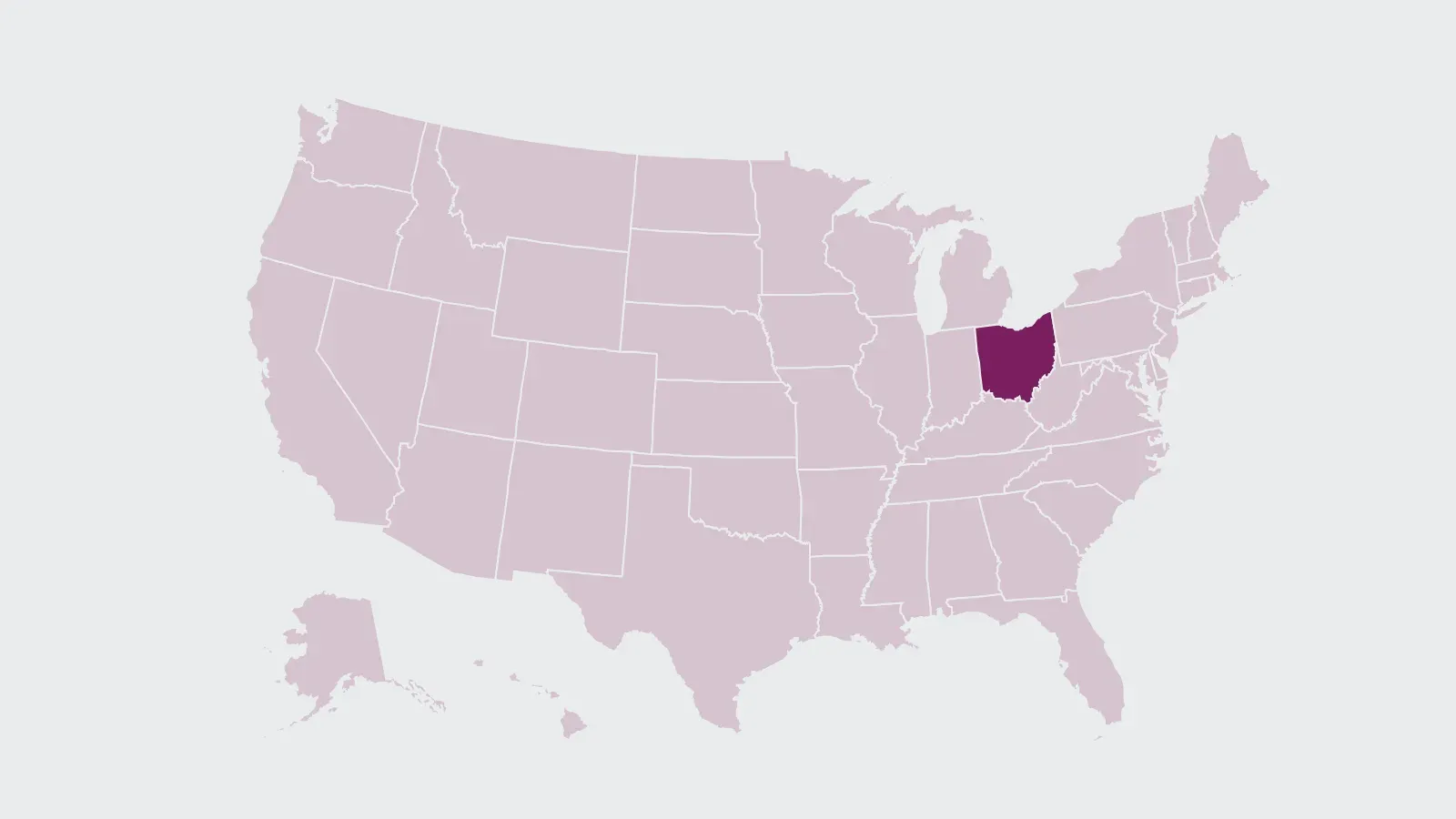
Price tier on the map
Under $1,000 a year
- Minimum liability limits
- 25/50/25
- Uninsured/underinsured motorist and medical payments coverage are optional
- Credit-based insurance scores
- Allowed
- Ohio Department of Insurance: ask for a yearly recheck and a re-rate after a credit report error is fixed
- Regulator
- Ohio Department of Insurance
Ohio's bill next to the national average
The National Association of Insurance Commissioners (NAIC) adds up what insurers charged in every state. In its most recent state tables, for 2023, Ohio's average expenditure was $947 per insured car. That was 13% more than the $835 of 2022, a slightly smaller rise than the national 14%. The expenditure figure blends liability-only cars with fully covered ones. A car carrying all three main coverages had a combined premium of $1,038.
| Coverage | Ohio | United States |
|---|---|---|
| Liability | $485 | $737 |
| Collision | $363 | $464 |
| Comprehensive | $189 | $238 |
| All three (combined premium) | $1,038 | $1,438 |
| Average expenditure | $947 | $1,282 |
Each line sits below the U.S. figure. The widest gap is in liability, the part of the bill that pays for damage you cause to others: $485 in Ohio against $737 nationally, about a third less. A full-coverage car came in roughly $400 under the U.S. combined premium. Your own price still turns on your car, your driving record and where the car is kept; our page on how location sets a price explains why two Ohio ZIP codes can be priced differently.
Coverage Ohio law requires
Ohio's financial responsibility law sets the floor at $25,000 for one person's injuries, $50,000 for all injuries in one accident and $25,000 for property damage: 25/50/25. The Ohio Department of Insurance (ODI) calls these bare minimums and points out that a serious crash can cost far more.
- Uninsured/underinsured motorist (UM/UIM) coverage is optional. A company may include it in a quote, and you can ask for a lower amount or turn it down. UM limits can't be higher than your liability limits.
- Medical payments coverage is optional too. It pays medical bills for you and your passengers up to a set amount, whoever was at fault.
- Collision and comprehensive aren't required by the state, but a lender or lessor usually requires both on a financed car.
With nearly one Ohio driver in five uninsured in 2023, by the Insurance Research Council's estimate, dropping UM/UIM is a real trade-off rather than free money. Driving without proof of insurance can cost you your license and your plates. Our guide to limits and deductibles shows how to weigh higher limits against the premium.
How prices are set in Ohio
ODI regulates car insurance premiums but does not set them. When a company wants to change its rates, it must file its rating plan and supporting data with the department, whose staff review it for compliance with Ohio law. Each insurer builds its own price, which is why the spread between companies can be wide.
Some Ohio insurers use credit scoring, usually through models they build themselves. ODI says you can ask your insurer to recheck your score once a year, and to re-rate your policy after an error on your credit report is corrected. Read more on how credit-based scores move a premium.
When regular insurers say no
A driver no company will cover, usually because of a poor driving record, can turn to the Ohio Automobile Insurance Plan. State law requires the Auto Plan to guarantee access to liability coverage, and an agent submits the application. ODI warns that its rates can be higher than those of companies that specialize in high-risk drivers, so it is worth asking for those quotes first. Our guide to assigned risk plans covers how these plans work.
Lowering an Ohio premium
- Get several quotes. ODI suggests asking several agents and companies and notes that a price isn't firm until the company checks your background. Compare the same limits and deductibles.
- Ask about the older driver discount. Drivers aged 60 to 70 can qualify by passing an accident prevention course approved by the Ohio Bureau of Motor Vehicles, with at least eight classroom hours and a driving test. ODI says most companies give 5% or 10% off the liability premium, and the discount lasts three years.
- Ask for the common discounts ODI lists: more than one car, good student, home and auto with one company, anti-theft devices and antilock brakes.
- Weigh your deductible. The deductible break-even calculator shows how long a higher deductible takes to pay for itself.
- Go to ODI if a dispute stalls. Start with your agent and the company. If that fails, call ODI Consumer Services at 800-686-1526 or file a complaint online.
Questions drivers ask
Is car insurance cheaper in Ohio than the national average?
On NAIC's 2023 figures, yes. Ohio's average expenditure was $947 per insured car against $1,282 nationally, and a fully covered car averaged $1,038 against $1,438.
What is the minimum car insurance in Ohio?
Liability of $25,000 per person and $50,000 per accident for injuries, plus $25,000 for property damage (25/50/25). Uninsured motorist and medical payments coverage are optional.
Can an Ohio insurer use my credit to price my policy?
Some do. The Ohio Department of Insurance says you can ask the company to recheck your score each year and to re-rate the policy after a credit report error is fixed. See credit-based insurance scores.
Is there a car insurance discount for older drivers in Ohio?
Drivers aged 60 to 70 who pass a BMV-approved accident prevention course can get a discount on the liability premium for three years. Each company sets the amount; ODI says 5% or 10% is most common.
Where the figures come from
- NAIC — Auto Insurance Database Report 2022/2023 (state average premiums and expenditures)
- Ohio Department of Insurance — Automobile insurance guide
- Ohio Department of Insurance — Automobile (consumer services contacts)
- Ohio Revised Code 4509.01 — Definitions, including proof of financial responsibility
- U.S. Bureau of Labor Statistics — CPI, table 2 (motor vehicle insurance)
- Insurance Information Institute — Uninsured motorists (Insurance Research Council estimates)
Facts on this page were checked against these sources on October 26, 2026. NAIC averages are for 2023, the latest year the NAIC has published by state.
Have your rate shopped
Averages can't price your car and your record. Tell us the basics of your policy and Guardbrook passes them to licensed insurance agents and insurers who can quote it; you decide whether to switch.
- 1 Your cars, drivers and current policy.
- 2 How agents can reach you, and your consent.
- 3 A licensed insurance agent or insurer contacts you with quotes. Your policy stays as it is until you decide to switch.
Guardbrook is not an insurance company or agency and doesn't sell, quote or bind policies. You pay Guardbrook nothing; the licensed insurance agents and insurers who contact you set their own prices and terms. How we make money.
Read next
-

Price factor
Age and driving experience
Teens have almost 3x the fatal crash rate of drivers 20+; HI, MA and NC limit age rating. Course discounts from 55.
-
Way to save
Defensive driving course discount
At least 10% in Minnesota for drivers 55+, 10% in Delaware at any age. State rules, how long it lasts, how to claim.
-
Shopping guide
Complaining about a rate increase
Ask the insurer, use your adverse action rights, read the filing, then complain; Maryland gives you 30 days.