$1,500 or more tier
What car insurance costs in New York
New York's average premium beside the national one, the no-fault system built into every policy, and the discounts state law makes insurers give.
By Guardbrook Editorial Team Updated 7 min read
At a glance
- Average yearly spend, 2023
- $1,753
- Change from 2022
- +13%
- Minimum liability limits
- 25/50/10 (50/100 death)
- Uninsured drivers, 2023
- 8.6%
Bottom line
New York drivers spent an average of $1,753 per insured car in 2023, about 37% more than the U.S. average of $1,282 and second only to Florida in the NAIC's state tables. Full coverage averaged $1,896. Every policy must carry 25/50/10 liability (50/100 for death), $50,000 of no-fault coverage and uninsured motorist coverage. Several discounts are required by statute, including one for an accident prevention course.
The New York bill, line by line
Guardbrook
Average car insurance bill, 2023
New York
Liability$1,116
Collision$541
Comprehensive$239
Full coverage$1,896
Average spend per car$1,753
Compared with the U.S.+37%
Uninsured drivers8.6%
Average yearly premiums per insured car (NAIC); uninsured share: Insurance Research Council estimate. Averages, not a quote. Where these numbers come from
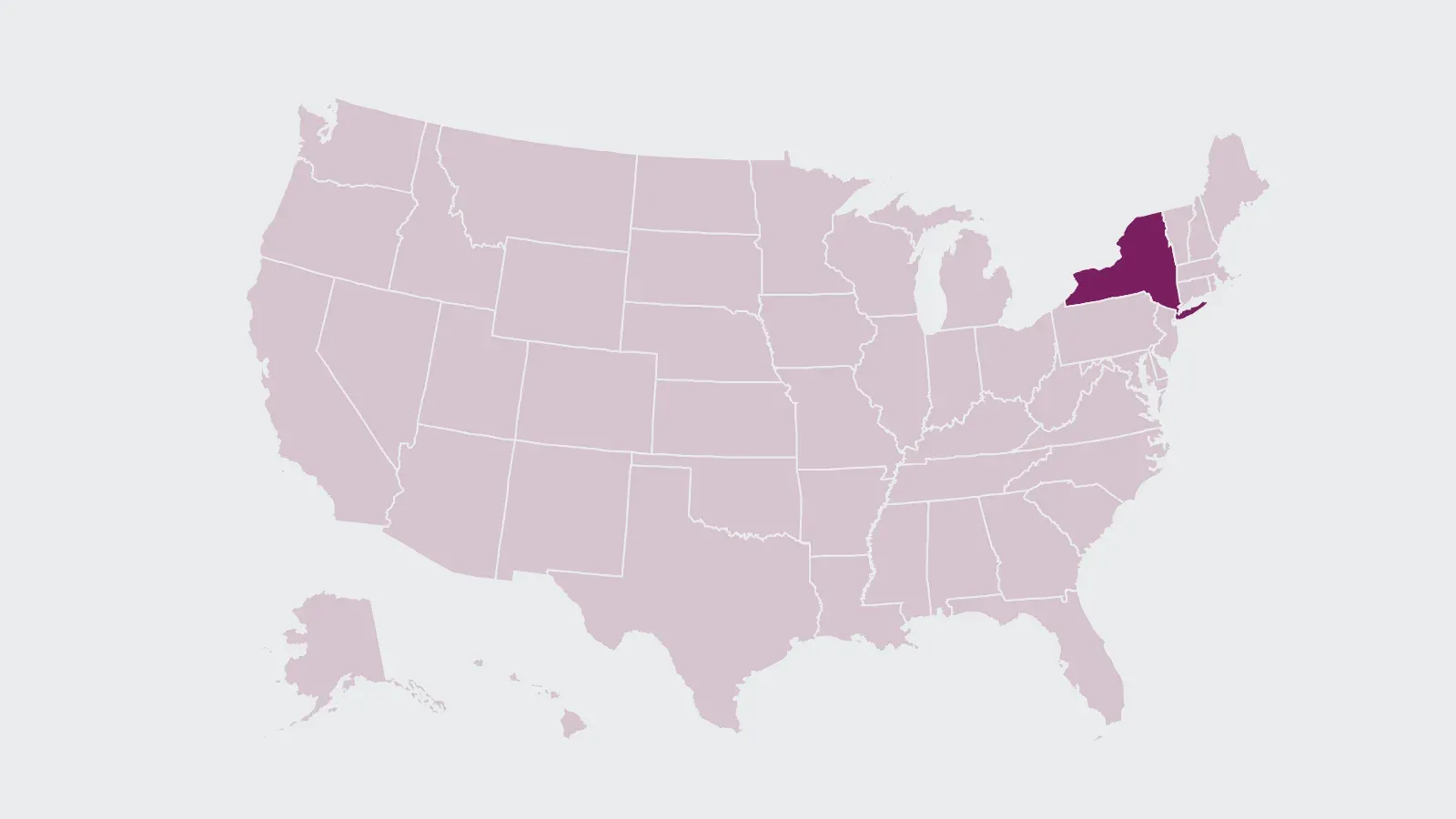
Price tier on the map
$1,500 or more a year
- Minimum liability limits
- 25/50/10 (50/100 for death)
- Plus $50,000 no-fault (PIP) and uninsured motorist coverage at the same minimums
- Credit-based insurance scores
- Allowed, with limits
- DFS: no cancellation or renewal increase based on credit; review on request at least every three years
- Regulator
- New York State Department of Financial Services
New York's bill beside the national average
The National Association of Insurance Commissioners (NAIC) gathers what insurers charged in each state. In 2023 the average New York expenditure was $1,753 per insured car, up 13% from $1,548 in 2022. That figure averages cars with liability only and cars with full coverage; a car carrying liability, collision and comprehensive averaged $1,896.
| Coverage | New York | United States |
|---|---|---|
| Liability | $1,116 | $737 |
| Collision | $541 | $464 |
| Comprehensive | $239 | $238 |
| All three (combined premium) | $1,896 | $1,438 |
| Average expenditure | $1,753 | $1,282 |
The liability line explains most of the gap. At $1,116 it is about 51% higher than the U.S. figure, and only Florida's was larger in 2023. Collision runs about 17% above the national number, while comprehensive is almost exactly average. A statewide average blends every county, from dense cities to rural towns, so it says little about one address; see how location moves a quote.
What New York requires on every policy
The New York DMV sets out the liability floor: $25,000 for injury to one person and $50,000 for injury to all persons in one accident, $50,000 and $100,000 when the injuries are fatal, and $10,000 for property damage. The DMV does not accept out-of-state insurance, and coverage has to stay in force as long as the registration is valid, even if the car sits unused. A lapse can cost you the registration and your license.
- No-fault (personal injury protection): $50,000 per person, paid regardless of who caused the crash. It covers medical costs, 80% of lost earnings up to $2,000 a month and a $2,000 death benefit for the driver, passengers and pedestrians your car hits. It pays before health insurance and never pays for car repairs.
- Uninsured motorist coverage for bodily injury is part of every policy at the same minimums.
- Supplementary uninsured/underinsured motorist (SUM) coverage is optional, up to your own bodily injury limits. If your limits are 250/500 or higher, insurers must offer SUM at 250/500.
Collision and comprehensive are optional under state law. Before you decide how much liability to carry above the minimum, read our guide to limits and deductibles.
Discounts New York law requires
The Department of Financial Services (DFS) lists discounts that every insurer must offer because a statute requires them. The one most drivers can act on is the accident prevention, or defensive driving, course: after you finish an approved course, insurers must apply a discount to the liability, collision and no-fault coverages for three years. The DMV publishes the list of approved course sponsors.
- Accident prevention (defensive driving) course
- Electronic tracking device
- Factory-installed anti-lock brakes
- Passive restraints such as airbags or automatic seat belts
- Factory-installed daytime running lamps
- Window glass etching
Beyond these, companies add their own discounts, such as multi-car, good student, accident-free and telematics programs, and each sets its own terms. Our page on the defensive driving course discount shows how to check that it has been applied.
Credit, and the Auto Plan for drivers turned down
Insurers that use credit information must follow consumer safeguards set by New York law. They must tell you they use it, send a notice naming the credit factors if your premium is higher because of it, and review your credit information on request at least every three years. A company may not cancel your policy or raise your renewal premium because of credit information.
If no company will sell you the required coverage, the New York Automobile Insurance Plan (NYAIP), known as the Auto Plan or Assigned Risk Plan, will. Most licensed agents and brokers can place you there, or call the plan at 212-943-5100. It sells the legal minimums, liability up to 250/500, and collision and comprehensive up to $50,000. DFS warns that Auto Plan premiums are generally higher. After three years you can stay or move to a regular insurer, sooner if one accepts you; see our guide to assigned risk plans.
Ways to bring a New York premium down
- Collect several quotes. DFS itself advises getting quotes from several insurers and publishes a list of auto insurers' phone numbers and websites. Keep the limits and deductibles identical.
- Take an approved accident prevention course and confirm the discount appears on your liability, collision and no-fault premiums for the next three years.
- Ask about every mandated equipment discount your car qualifies for, from anti-lock brakes to window etching.
- Check complaint rankings and complain if needed. DFS ranks auto insurers by upheld complaints and takes complaints online.
Questions drivers ask
What are the minimum car insurance requirements in New York?
Liability of $25,000/$50,000 for injury ($50,000/$100,000 for death) and $10,000 for property damage, $50,000 of no-fault coverage, and uninsured motorist coverage for bodily injury.
Why is car insurance so expensive in New York?
The NAIC data show where the money goes rather than why: New York's 2023 liability average was $1,116 against $737 nationally, while comprehensive matched the U.S. average.
How long does the New York defensive driving discount last?
Three years. After an approved accident prevention course, insurers must discount your liability, collision and no-fault premiums for that period.
Can a New York insurer raise my renewal premium because of my credit?
No. Insurers that use credit may not cancel your policy or increase your renewal premium based on credit information. See credit-based insurance scores.
Where the figures come from
- NAIC — Auto Insurance Database Report 2022/2023 (state average premiums and expenditures)
- New York DFS — How much auto insurance must I carry?
- New York DFS — Auto Insurance resource center (no-fault, credit, Auto Plan)
- New York DFS — Auto insurance discounts list
- New York DMV — Insurance requirements
- New York DFS — File a complaint
- Insurance Information Institute — Uninsured motorists (Insurance Research Council estimates)
Facts on this page were checked against these sources on October 26, 2026. NAIC averages are for 2023, the latest year the NAIC has published by state.
Have your rate shopped
Averages can't price your car and your record. Tell us the basics of your policy and Guardbrook passes them to licensed insurance agents and insurers who can quote it; you decide whether to switch.
- 1 Your cars, drivers and current policy.
- 2 How agents can reach you, and your consent.
- 3 A licensed insurance agent or insurer contacts you with quotes. Your policy stays as it is until you decide to switch.
Guardbrook is not an insurance company or agency and doesn't sell, quote or bind policies. You pay Guardbrook nothing; the licensed insurance agents and insurers who contact you set their own prices and terms. How we make money.
Read next
-

Way to save
Defensive driving course discount
At least 10% in Minnesota for drivers 55+, 10% in Delaware at any age. State rules, how long it lasts, how to claim.
-
Price factor
Location and ZIP code
2023 state averages ran from $808 to $1,864 per car. Why your address matters and where ZIP codes are barred.
-

Shopping guide
Assigned-risk plans
Turned down twice in Texas or Maryland? How state plans place you, what they cover and how to get back out.