Under $1,000 tier
What car insurance costs in Kansas
The average Kansas premium coverage by coverage, the no-fault benefits every policy must carry, and the levers a Kansas driver can pull.
By Guardbrook Editorial Team Updated 6 min read
At a glance
- Average yearly spend, 2023
- $973
- Change from 2022
- +12%
- Minimum liability limits
- 25/50/25
- Uninsured drivers, 2023
- 12.0%
Bottom line
Kansas drivers spent an average of $973 per insured car in 2023, about 24% under the U.S. average of $1,282; a car with all three main coverages averaged $1,182. Comprehensive is the exception, running well above the national figure. Kansas is a no-fault state: besides 25/50/25 liability and uninsured motorist coverage, every policy carries personal injury protection. Insurers file rates and can use them after a 30-day wait, so shopping still pays.
The Kansas bill, line by line
Guardbrook
Average car insurance bill, 2023
Kansas
Liability$483
Collision$349
Comprehensive$349
Full coverage$1,182
Average spend per car$973
Compared with the U.S.−24%
Uninsured drivers12.0%
Average yearly premiums per insured car (NAIC); uninsured share: Insurance Research Council estimate. Averages, not a quote. Where these numbers come from
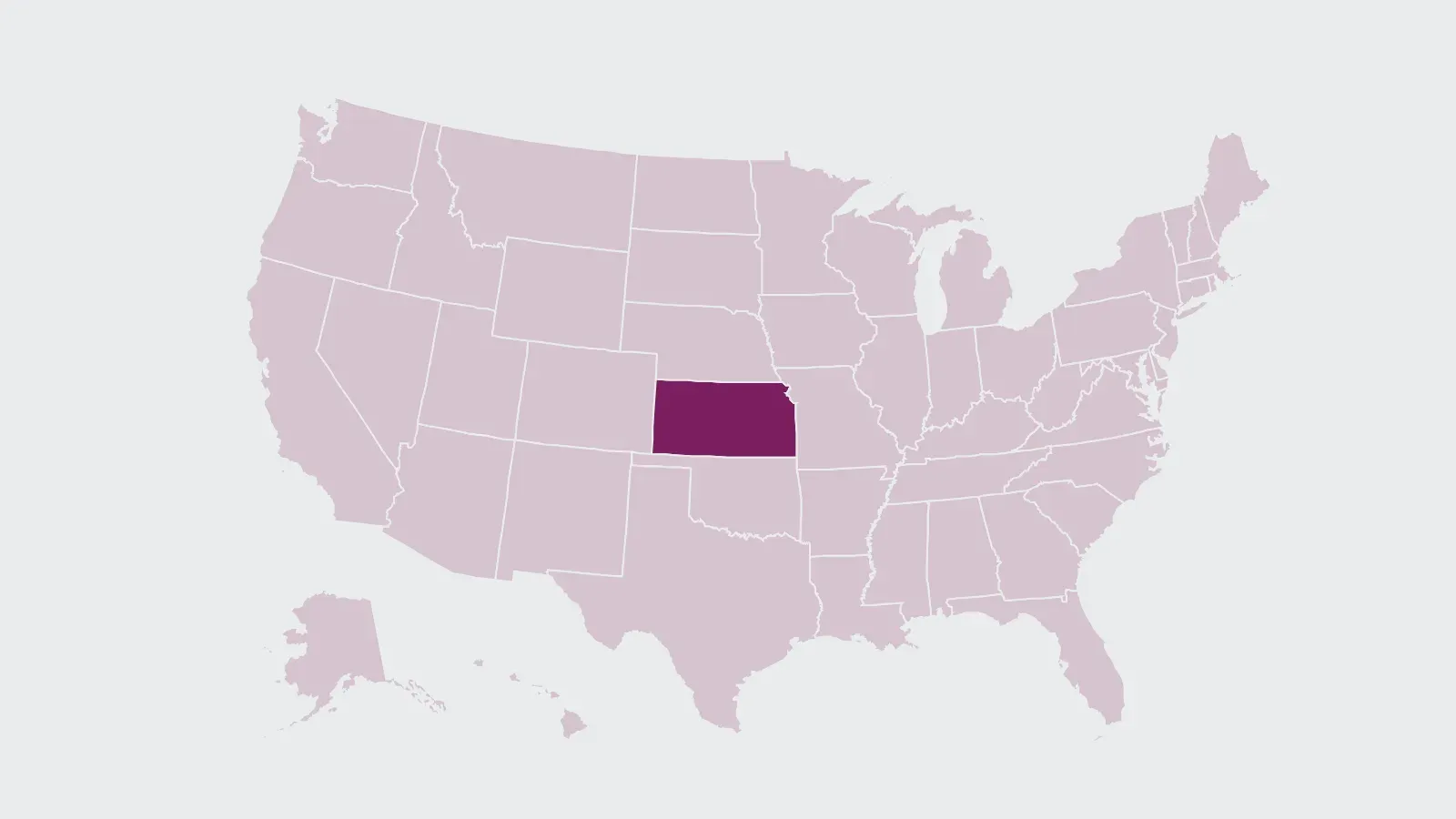
Price tier on the map
Under $1,000 a year
- Minimum liability limits
- 25/50/25
- No-fault: PIP required ($4,500 medical minimum); uninsured motorist coverage required
- Credit-based insurance scores
- Allowed, not as the only factor
- Kansas Insurance Score Act, K.S.A. 40-5104
- Regulator
- Kansas Department of Insurance
The Kansas bill against the U.S. average
The National Association of Insurance Commissioners (NAIC) tracks the premiums insurers collect in each state. Its newest state figures, for 2023, show an average Kansas expenditure of $973 per insured car, up 12% from $868 the year before. Because that average includes cars insured for liability only, the NAIC also reports a combined premium for cars with liability, collision and comprehensive: $1,182 in Kansas.
| Coverage | Kansas | United States |
|---|---|---|
| Liability | $483 | $737 |
| Collision | $349 | $464 |
| Comprehensive | $349 | $238 |
| All three (combined premium) | $1,182 | $1,438 |
| Average expenditure | $973 | $1,282 |
Liability, about two-thirds of the national average, keeps the Kansas total low. Comprehensive pulls the other way: at $349 it is close to half again the U.S. figure and as large as the collision premium. Comprehensive pays for damage that doesn't come from a crash, such as hail, wind, fire and theft, so on a fully covered car it deserves a close look. Where you live within the state also matters; see how location affects price.
Kansas no-fault, and the rest of the minimum
Kansas Statutes 40-3107 require liability limits of at least $25,000 per injured person, $50,000 per accident for injuries and $25,000 for property damage. The same section requires personal injury protection (PIP), which pays your own side's injury costs whoever caused the crash. Its minimum benefits, set in K.S.A. 40-3103, are:
- Medical expenses of at least $4,500 per person, and at least $4,500 for rehabilitation.
- Lost earnings of at least $900 a month, for up to one year of disability.
- Replacement services up to $25 a day for up to 365 days, for chores the injured person can't do.
- Funeral costs up to $2,000, and survivors' benefits of at least $900 a month for up to a year.
Uninsured motorist coverage, which includes underinsured motorist protection, is also mandatory under K.S.A. 40-284, at limits equal to the bodily injury liability you buy. You can turn down in writing only the part above the state minimums. With 12.0% of Kansas drivers uninsured in 2023, by the Insurance Research Council's estimate, that floor matters.
The trade-off for PIP is a limit on lawsuits. Under K.S.A. 40-3117, you can sue another driver for pain and suffering only if your medical treatment is worth $2,000 or more, or the injury involves a broken weight-bearing bone, a compound, displaced or compressed fracture, permanent disfigurement or injury, the loss of a body part or bodily function, or death. Raising limits above the minimum costs extra; our page on limits and deductibles helps you size them.
How Kansas oversees rates and credit
For personal car insurance, Kansas uses a waiting period rather than approval in advance. Under K.S.A. 40-955, an insurer files its rates with the commissioner, and the filing takes effect after 30 days unless the commissioner disapproves it as excessive, inadequate or unfairly discriminatory. Companies still price the same driver differently.
The Kansas Insurance Score Act (K.S.A. 40-5104) lets insurers use credit, with guardrails. A company can't refuse to quote, deny, cancel or decline to renew a policy based on credit alone, or set a renewal rate on credit alone. It can't hold medical collections or your own credit checks against you, and adverse action needs a credit report no more than 90 days old. At renewal you can ask to be re-rated on current credit once a year; the new score can only lower the rate, with some exceptions. See how credit-based scores work.
Coverage when companies turn you away
The Kansas Automobile Insurance Plan sells car insurance to eligible drivers who can't buy it in the regular market. Any agent licensed to sell car insurance in Kansas can submit an application. Our guide to assigned-risk plans explains how to use one as a stopgap.
Cutting a Kansas premium
- Take an accident prevention course. Kansas law requires car insurers to reduce premiums when the principal operator completes an approved accident avoidance course of at least four hours. Ask your insurer which courses it accepts; the Insurance Department doesn't approve them.
- Compare at least three quotes with the same PIP, liability limits and deductibles, then check them line by line.
- Price your comprehensive deductible. Comprehensive is the Kansas line furthest above the national average, and a higher deductible lowers it.
- Call for help if needed. The Kansas Department of Insurance consumer hotline is 800-432-2484.
Questions drivers ask
Is car insurance in Kansas cheaper than the national average?
Yes, on average. The NAIC put Kansas's 2023 expenditure at $973 per insured car against $1,282 nationally, and the full-coverage combined premium at $1,182 against $1,438.
Is Kansas a no-fault state?
Yes. Every policy includes personal injury protection, which pays at least $4,500 in medical expenses per person regardless of fault, and lawsuits for pain and suffering are limited to injuries that cross the $2,000 medical threshold or meet the serious-injury list in K.S.A. 40-3117.
Can I drop uninsured motorist coverage in Kansas?
Not entirely. It is required at least at the minimum liability limits; you can reject in writing only coverage above those limits.
Do Kansas insurers have to give a defensive driving discount?
Kansas law requires a premium reduction when the principal operator completes an approved accident prevention course of at least four hours. Each insurer sets the amount. More on course discounts.
Where the figures come from
- NAIC — Auto Insurance Database Report 2022/2023 (state average premiums and expenditures)
- Kansas Department of Insurance — Auto insurance
- K.S.A. 40-3107 — Required policy provisions (Justia)
- K.S.A. 40-3103 — Definitions of PIP benefits (Justia)
- K.S.A. 40-3117 — Tort threshold (Justia)
- K.S.A. 40-284 — Uninsured motorist coverage (Justia)
- K.S.A. 40-955 — Rate filings (Justia)
- K.S.A. 40-5104 — Insurance Score Act, prohibited acts (Justia)
- AIPSO — Kansas Automobile Insurance Plan
- Insurance Information Institute — Uninsured motorists (Insurance Research Council estimates)
Facts on this page were checked against these sources on October 26, 2026. NAIC averages are for 2023, the latest year the NAIC has published by state.
Have your rate shopped
Averages can't price your car and your record. Tell us the basics of your policy and Guardbrook passes them to licensed insurance agents and insurers who can quote it; you decide whether to switch.
- 1 Your cars, drivers and current policy.
- 2 How agents can reach you, and your consent.
- 3 A licensed insurance agent or insurer contacts you with quotes. Your policy stays as it is until you decide to switch.
Guardbrook is not an insurance company or agency and doesn't sell, quote or bind policies. You pay Guardbrook nothing; the licensed insurance agents and insurers who contact you set their own prices and terms. How we make money.
Read next
-
Price factor
Claims history
A CLUE report shows up to 7 years of auto claims. Get a free copy every 12 months and fix errors before you shop.
-
Way to save
Defensive driving course discount
At least 10% in Minnesota for drivers 55+, 10% in Delaware at any age. State rules, how long it lasts, how to claim.
-
Shopping guide
Why your premium went up
Market-wide changes vs. your own record. The price index fell 5.0% to September 2026; yours may not have.