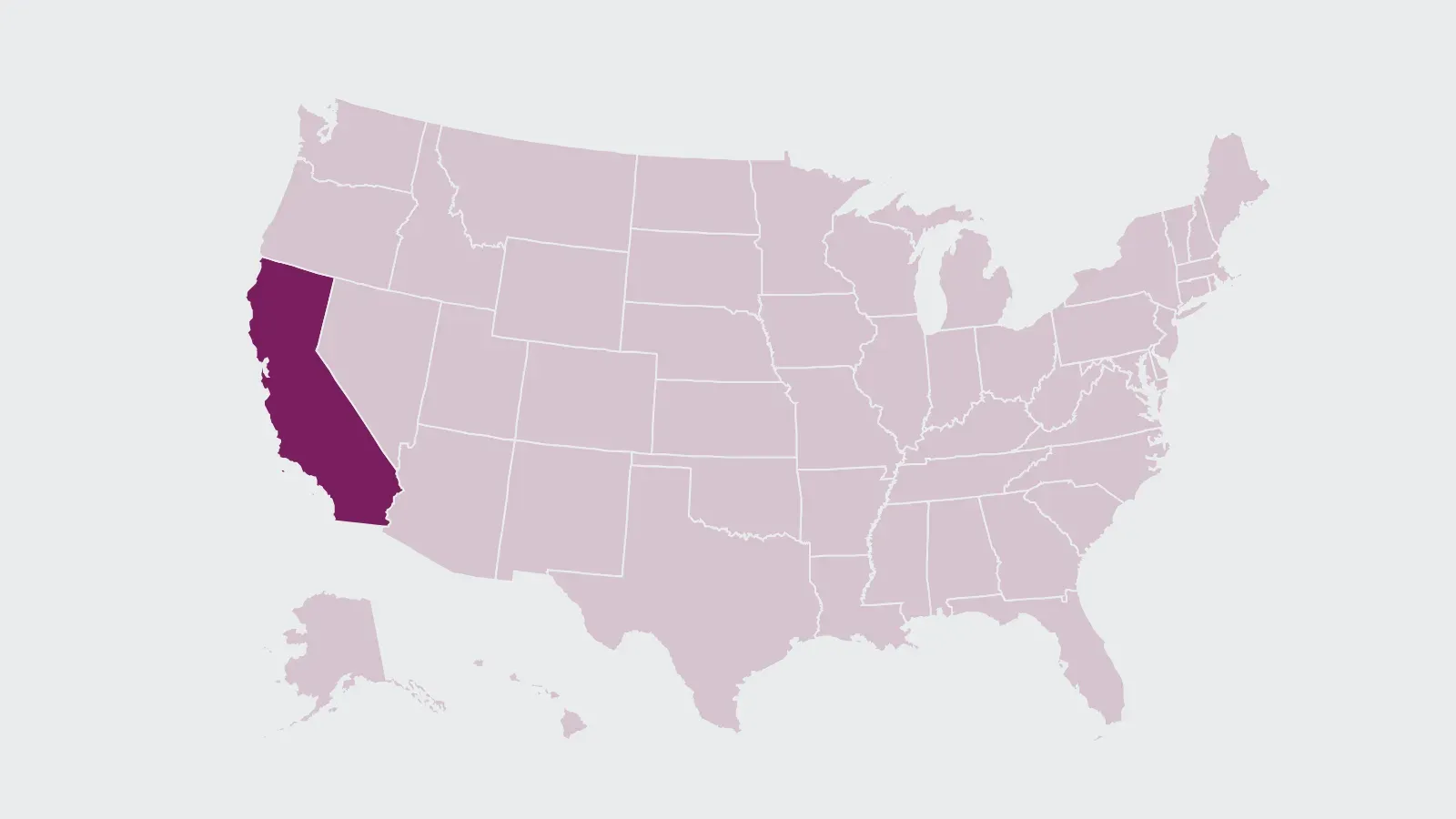
$1,000–$1,249 tier
What car insurance costs in California
California's average premium against the U.S., the coverage the law requires since 2025, how the state polices prices, and the programs that can lower a bill.
By Guardbrook Editorial Team Updated 6 min read
At a glance
- Average yearly spend, 2023
- $1,223
- Change from 2022
- +13%
- Minimum liability limits
- 30/60/15
- Uninsured drivers, 2023
- 20.4%
Bottom line
California drivers spent an average of $1,223 per insured car in 2023, about 5% below the U.S. average of $1,282; full coverage averaged $1,417. The minimum rose to 30/60/15 on January 1, 2025. Rate filings go through the Department of Insurance's prior-approval process under Proposition 103, credit scores aren't allowed in auto pricing, and Good Driver rates must be at least 20% lower. Income-eligible drivers can look at the California Low Cost Auto Insurance Program.
The California bill, line by line
Guardbrook
Average car insurance bill, 2023
California
Liability$660
Collision$607
Comprehensive$150
Full coverage$1,417
Average spend per car$1,223
Compared with the U.S.−5%
Uninsured drivers20.4%
Average yearly premiums per insured car (NAIC); uninsured share: Insurance Research Council estimate. Averages, not a quote. Where these numbers come from
Price tier on the map
$1,000 to $1,249 a year
- Minimum liability limits
- 30/60/15
- In effect since January 1, 2025 (SB 1107; CDI Bulletin 2023-1)
- Credit-based insurance scores
- Not allowed in auto pricing
- Rates follow Proposition 103 prior-approval rules (California Department of Insurance)
- Regulator
- California Department of Insurance
California's average bill, coverage by coverage
The National Association of Insurance Commissioners (NAIC) compiles what insurers charged per insured car in each state. In its latest state data, for 2023, California's average expenditure was $1,223, up 13% from $1,087 in 2022. That average mixes liability-only and fully covered cars; a car carrying liability, collision and comprehensive had a combined premium of $1,417.
| Coverage | California | United States |
|---|---|---|
| Liability | $660 | $737 |
| Collision | $607 | $464 |
| Comprehensive | $150 | $238 |
| All three (combined premium) | $1,417 | $1,438 |
| Average expenditure | $1,223 | $1,282 |
California's lines pull in opposite directions. Collision, at $607, was about 31% above the national average, the one line well above the U.S. figure. Comprehensive, at $150, was about 37% lower, and liability about 10% lower. The result is a full-coverage price almost level with the U.S. ($1,417 against $1,438). Your own price still depends on how much and where you drive; see how annual mileage factors in.
The coverage California requires
Since January 1, 2025, California's minimum liability is $30,000 for injury or death of one person, $60,000 for injury or death of more than one person in an accident and $15,000 for property damage: 30/60/15. The California Department of Insurance (CDI) announced the change in a bulletin on Senate Bill 1107, and the DMV's driver handbook lists the same amounts.
- Uninsured and underinsured motorist coverage pays for injuries to you and your passengers when an at-fault driver has no insurance or too little. The Insurance Research Council estimated 20.4% of California drivers were uninsured in 2023, well above the 15.4% U.S. figure.
- Uninsured motorist property damage pays for damage to your car caused by an at-fault uninsured driver if you don't carry collision, CDI's guide explains.
- Collision and comprehensive are your choice under state law; a lender or leasing company sets its own requirements.
With about one driver in five uninsured, uninsured motorist coverage carries more weight in California than in most states. Our page on limits and deductibles walks through how much coverage each dollar buys.
Proposition 103 and how prices are set
California's property and casualty rates fall under the prior-approval rules that grew out of Proposition 103: insurers file rate changes with CDI, which reviews them, and the department publishes notices of rate filings. CDI also runs an online sample-rate comparison for private passenger auto; it shows survey results by company, not quotes.
California does not allow credit-based insurance scores in auto pricing, so your credit history doesn't set your car insurance rate there. What does matter is your driving record: CDI's guide says a driver licensed for at least three consecutive years with no more than one point qualifies as a Good Driver, and Good Driver rates must be at least 20% lower than the same company's rates for other drivers. More on safe-driver discounts.
Low-cost and last-resort coverage
The California Low Cost Automobile Insurance Program offers state-minimum-style liability to income-eligible good drivers. Its coverage page lists up to $10,000 per person and $20,000 per accident for bodily injury and $3,000 for property damage, with optional uninsured motorist bodily injury and $1,000 of medical payments. It doesn't cover theft or damage to your own car. Applicants need to have been licensed continuously for three years, and the premium depends on your county; call 866-602-8861 or apply at mylowcostauto.com.
A driver turned down by regular insurers can apply to the California Automobile Assigned Risk Plan (CAARP), administered by AIPSO, for drivers entitled to insurance who can't get it through ordinary methods. Our guides to state low-cost programs and assigned-risk plans compare both.
Where a California driver can save
- Start with CDI's sample rates. The department's online comparison shows sample rates from insurers. They aren't quotes, but they help you choose whom to ask.
- Keep your Good Driver status. More than one point on your record ends Good Driver eligibility, so check your record before renewal.
- Test a higher deductible. With collision costing more than in most states, the deductible break-even calculator is worth a look.
- Call CDI with a problem. The consumer hotline is 1-800-927-4357 (TTY 1-800-482-4833), and complaints can be filed online.
Questions drivers ask
Is car insurance more expensive in California than the U.S. average?
Not on average. NAIC's 2023 figures show $1,223 per insured car in California against $1,282 nationally. Collision, however, cost about 31% more than the U.S. average.
What is the minimum car insurance in California?
30/60/15 since January 1, 2025: $30,000 for one person's injuries, $60,000 per accident and $15,000 for property damage.
Does my credit score affect car insurance in California?
No. California does not allow credit-based insurance scores in auto pricing. See credit-based insurance scores for how other states differ.
Who qualifies for California's Low Cost Auto Insurance?
Income-eligible drivers who have been licensed continuously for three years and meet the program's other conditions. Coverage is liability only, with optional uninsured motorist and medical payments.
Where the figures come from
- NAIC — Auto Insurance Database Report 2022/2023 (state average premiums and expenditures)
- California Department of Insurance — Bulletin 2023-1 on SB 1107 minimum limits
- California Department of Insurance — Automobile insurance guide (February 2025)
- California Department of Insurance — Property and casualty rate filings
- California Department of Insurance — Compare premiums
- California DMV — Financial responsibility and insurance requirements
- California Low Cost Automobile Insurance Program — Coverage
- AIPSO — California Automobile Assigned Risk Plan
- Insurance Information Institute — Uninsured motorists (Insurance Research Council estimates)
Facts on this page were checked against these sources on October 26, 2026. NAIC averages are for 2023, the latest year the NAIC has published by state, and predate the 30/60/15 minimum that took effect in 2025.
Have your rate shopped
Averages can't price your car and your record. Tell us the basics of your policy and Guardbrook passes them to licensed insurance agents and insurers who can quote it; you decide whether to switch.
- 1 Your cars, drivers and current policy.
- 2 How agents can reach you, and your consent.
- 3 A licensed insurance agent or insurer contacts you with quotes. Your policy stays as it is until you decide to switch.
Guardbrook is not an insurance company or agency and doesn't sell, quote or bind policies. You pay Guardbrook nothing; the licensed insurance agents and insurers who contact you set their own prices and terms. How we make money.
Read next
-
Price factor
Annual mileage
One of three rating factors named in California law, and a common discount elsewhere. How miles are checked.
-

Shopping guide
State low-cost programs
California's 10/20/3 policy, New Jersey's $365 Medicaid policy, Hawaii's free minimums and Maryland's MAIF.
-
Way to save
Safe driver discounts
California's Good Driver rates must be at least 20% lower. What qualifies and what can cost you the discount.